



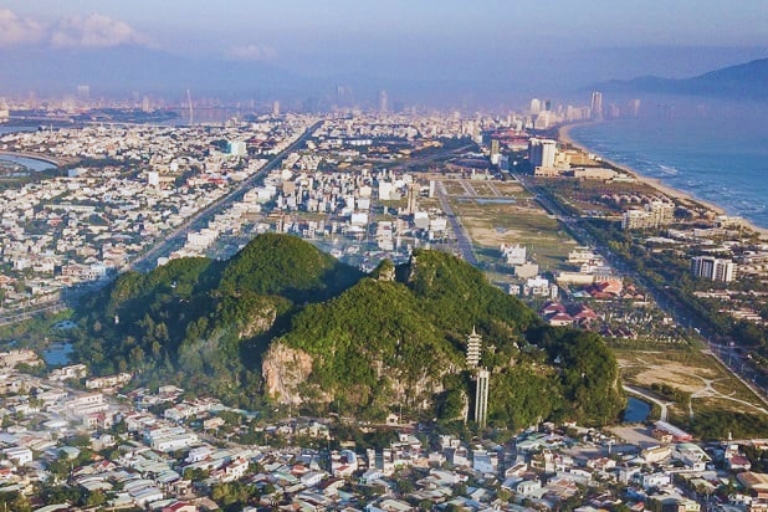
Marble Mountains Da Nang: A Thousand-Year Legacy of Heaven and Earth
From ancient times, locals have passed down the saying:
“Once, nature formed the Five Elements as islands upon the sea;
A millennium hence, they rose as the renowned Mountains of the Five Elements”
Which means:
“A thousand years ago, the Marble Mountains were islands in the sea;
A thousand years later, they became a heavenly masterpiece bestowed by nature.”
The verse inscribed on the stele at Linh Ung Pagoda not only praises the majestic beauty of the mountains but also recalls the story of their natural formation. According to geologists, millions of years ago, this area was once a cluster of small islands in the East Sea. Over time, the Thu Bon River and its tributaries carried alluvial deposits that gradually connected these islands to the mainland, forming the fertile Quang Nam plain we see today — where the Marble Mountains stand as a mystical highlight of Da Nang.
The Legend Born from the Heart of the Sea

Long ago, when Da Nang was still a wild and untouched land, there lived an old fisherman by the sea. One day, he witnessed a giant dragon soaring down from the sky to lay a large egg before disappearing beneath the waves. Soon after, the Golden Turtle God (Kim Quy) appeared and gave the old man a claw, instructing him to protect the “blood of the Dragon Lord.”
The old man obeyed and guarded the egg with all his heart. One night, the egg hatched — its shell shattered into five great pieces of stone that rose majestically beside the sea. From then on, the people called this place Ngu Hanh Son – The Five Elements Mountains, symbolizing the five elements that make up the universe: Metal (Kim), Wood (Moc), Water (Thuy), Fire (Hoa), and Earth (Tho).
Location and Meaning Behind the Legendary Name
About 11 km southeast of Da Nang’s city center lies a breathtaking cluster of limestone mountains known as The Marble Mountains — a natural and spiritual wonder where heaven and earth seem to merge.
The five peaks, named after the Five Elements philosophy — Metal, Wood, Water, Fire, and Earth — rise gracefully from sandy plains. To the east lies the picturesque Non Nuoc Beach, to the west the gentle Cam Le River, to the south the ancient town of Hoi An, and to the north the bustling Son Tra District.
The name “Ngu Hanh Son” was bestowed by Emperor Minh Mang in 1837. Each mountain has its own distinctive rock color and character:
- Thuy Son (Water Mountain) – the largest, filled with pagodas and caves, serving as the main tourist attraction.
- Moc Son (Wood Mountain) – home to a white marble block resembling the Bodhisattva of Mercy.
- Hoa Son (Fire Mountain) – actually two mountains, Yin Fire and Yang Fire, known for their reddish hue.
- Kim Son (Metal Mountain) – located near the Co Co River, with rocks that shimmer in silver-gray tones.
- Tho Son (Earth Mountain) – the lowest and longest, blanketed in lush greenery.
Journey Through the Five Mountains – The Five Symbols of the Universe
1. Thuy Son – The Imperial Footprints Amid the Marble Mountains

Standing about 106 meters above sea level and spanning nearly 7 hectares, Thuy Son is regarded as the brightest gem of the Marble Mountains. With its majestic shape mirrored in the Non Nuoc Sea, Thuy Son combines natural poetry with profound spirituality, housing numerous ancient temples and mysterious caves.
Directions to Thuy Son, Ngu Hanh Son, Da Nang
https://www.google.com/maps/dir//Th%E1%BB%A7y+S%C6%A1n,+H%C3%B2a+H%E1%BA%A3i,+Ng%C5%A9+H%C3%A0nh+S%C6%A1n,+%C4%90%C3%A0+N%E1%BA%B5ng
At the foot of the mountain lies the Non Nuoc Stone Carving Village, a renowned craft community over 400 years old. The rhythmic sound of chisels and hammers each morning is the heartbeat of this land. Each marble block, shaped by skilled hands, becomes an artistic and spiritual masterpiece exported worldwide.
Ascending the winding stone steps of Thuy Son feels like walking through time — where rock, light, and faith harmonize. Within the mountain are awe-inspiring natural sanctuaries:
- Huyen Khong Cave, where sunlight streams through the stone dome, mingling with incense smoke to create a mystical, ethereal glow.
- Am Phu Cave, symbolizing the human journey through good and evil, cause and effect — a spiritual reminder of compassion and awakening.


2. Moc Son – The Silent Grace of the Mountains

The peak of Moc Son has a serrated, rugged form resembling a rooster’s comb — hence its local name, Mount Mo Ga (Rooster Mountain). (Source: Collected)
Running parallel to Thuy Son, Moc Son is simpler yet serene. Composed mostly of white marble, it gleams like a giant jade amidst golden sand dunes. Its most famous feature is the Buddha Rock — a massive stone naturally shaped like a meditating Avalokitesvara (Guanyin). Locals believe that at dawn, sunlight touching the stone emits a soft halo — a sign of peace and enlightenment.
Though lacking many caves, Moc Son offers quiet solitude — a place for visitors to let go of worldly troubles and listen to the whispers of wind through stone and leaves.
3. Hoa Son – The Fiery Mountain of Passion and Spirit

From afar, their reddish rocks blaze like eternal flames against the blue sky. Yang Fire Mountain lies near the Co Co River, home to small caves and hidden temples, while Yin Fire Mountain is quieter and more mysterious.
Legends say monks once meditated here, seeking inner peace amid incense and stillness. At sunset, the mountains glow crimson — a breathtaking scene of both power and sanctity.
Directions to Hoa Son, Ngu Hanh Son:
4. Kim Son – The Shimmering Beauty Beside the Co Co River

Kim Son, located southeast of the cluster, mirrors itself upon the tranquil Co Co River. True to its name, the mountain’s silver-gray stones gleam like gold under the sunlight.
Here stands Quan The Am Pagoda, a sacred Buddhist site built in the 1950s. Inside the mountain lies Quan Am Cave, a natural marvel where stone formations resemble the image of the Goddess of Mercy sitting serenely on a lotus pedestal.
Every year, during the Quan The Am Festival (held in the second lunar month), thousands of pilgrims and visitors come to pray and find peace within.
Directions to Kim Son, Ngu Hanh Son
5. Tho Son – The Gentle Silence of Mother Earth

Directions to Tho Son, Ngu Hanh Son
Located to the northwest of the cluster, Tho Son — also known as Da Chong Mountain or Ghenh Mountain — is the lowest yet longest of the five. Its form resembles a dragon resting upon the golden sands.
With its modest beauty and lush greenery, Tho Son embodies the nurturing essence of the Earth. According to locals, it was once a retreat for monks and hermits. Within its slopes lie small caves and remnants of ancient pagodas now covered in moss. From its summit, visitors can gaze upon the entire Marble Mountains, rising in the formation of “dragons bowing and tigers crouching” amidst the vast ocean sky.

Tips for a Perfect Visit
- Wear comfortable shoes or sandals with good grip.
- Bring water, hats, and sunscreen.
- Avoid climbing on rainy days due to slippery steps.
- Elderly visitors or children can use the elevator up Thuy Son to save energy.
Best time to visit:
- Morning (6–9 AM): Cool and pleasant, ideal for hiking and photography.
- Afternoon (3–5 PM): Sunset paints the stones gold, creating an unforgettable scene.
- Avoid midday heat, as stone paths can get slippery.
End of the Journey – Retreat at Furama Villas Da Nang

A perfect day comes to a close at Furama Villas – where the soul finds its peace
Indulge in a luxurious seafood buffet, the culinary highlight of your stay, featuring the freshest catches from Da Nang’s vibrant coast.
Relax in the private villa pool, enjoy an intimate seaside dinner, or simply listen to the gentle rhythm of the waves as you embrace tranquility after a day of discovery.
Ending your journey among stone, sea, and spirit, Furama Villas Da Nang is the perfect sanctuary — where travelers find harmony between exploration and relaxation, between the timeless legend of the Marble Mountains and the modern rhythm of Da Nang.